How expensive is housing in Essex County?
Housing affordability is a persistent challenge in Essex County. Since 2010-14, the median home value has increased 34%, reaching $619,100. Essex remains an expensive place to live, both for homeowners and renters. For homeowners, affordability is assessed using a ratio of median home value to median income. Essex County’s ratio is 6.1, more than double the generally accepted affordable ratio of less than 2 or 3. For renters, rent is considered affordable if it takes up no more than 30% of income. In Essex County, renters are spending about 39% of their income on rent.
Who owns a home in Essex County?
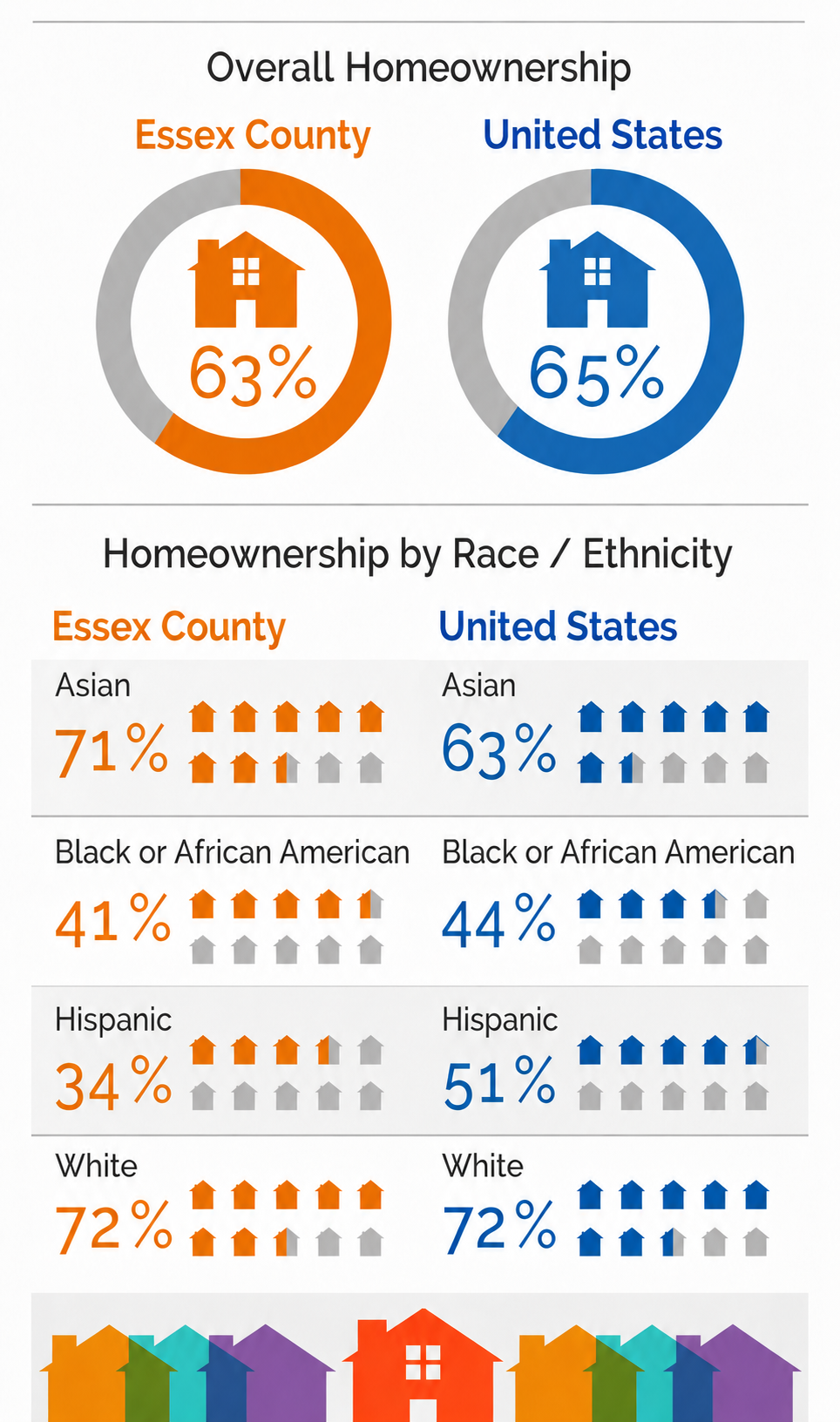
Homeownership in Essex has been steady since 2010-14, with 63% of housing units occupied by owners. But in some local areas, and for some groups, homeownership is far less common. Only 28% of homes in Lawrence were owner-occupied in 2020-24, along with 48% in Lynn and 50% in Salem. Homeownership rates were 71% among White and Asian residents, but just 41% for African Americans and 34% for Hispanics. Relative to the nation, Essex County has a higher homeownership rate among Asian residents, a similar rate for Whites, and lower rates for African Americans and Hispanics.
Local zoning laws make it difficult to develop affordable and/or multi-family housing in some areas. Some towns allow only single-family homes on large lots, which limits housing supply and escalates costs. The Commonwealth enacted Chapter 40B in 1969 to mitigate this problem by setting a goal that 10 percent of housing inventory in each town or city is affordable. However, in Essex County, just 11 of 34 communities have met this goal: Amesbury, Andover, Beverly, Danvers, Georgetown, Lawrence, Lynn, Lynnfield, Salem, Salisbury and Wenham.
At the extreme end of the affordable housing issue, people become unhoused. While government has changed the way homeless data is reported and we no longer have data for Essex County as a whole, we know that in Lynn, the rate of homelessness has almost quadrupled since 2007 to a rate of 106 people per 10,000 identified during a point-in-time count in 2024. Homelessness data for Essex County is now included in the statewide rate which was 41 per 10,000 people in 2024, an increase of 58% from 26 in 2020.
What factors drive housing challenges?
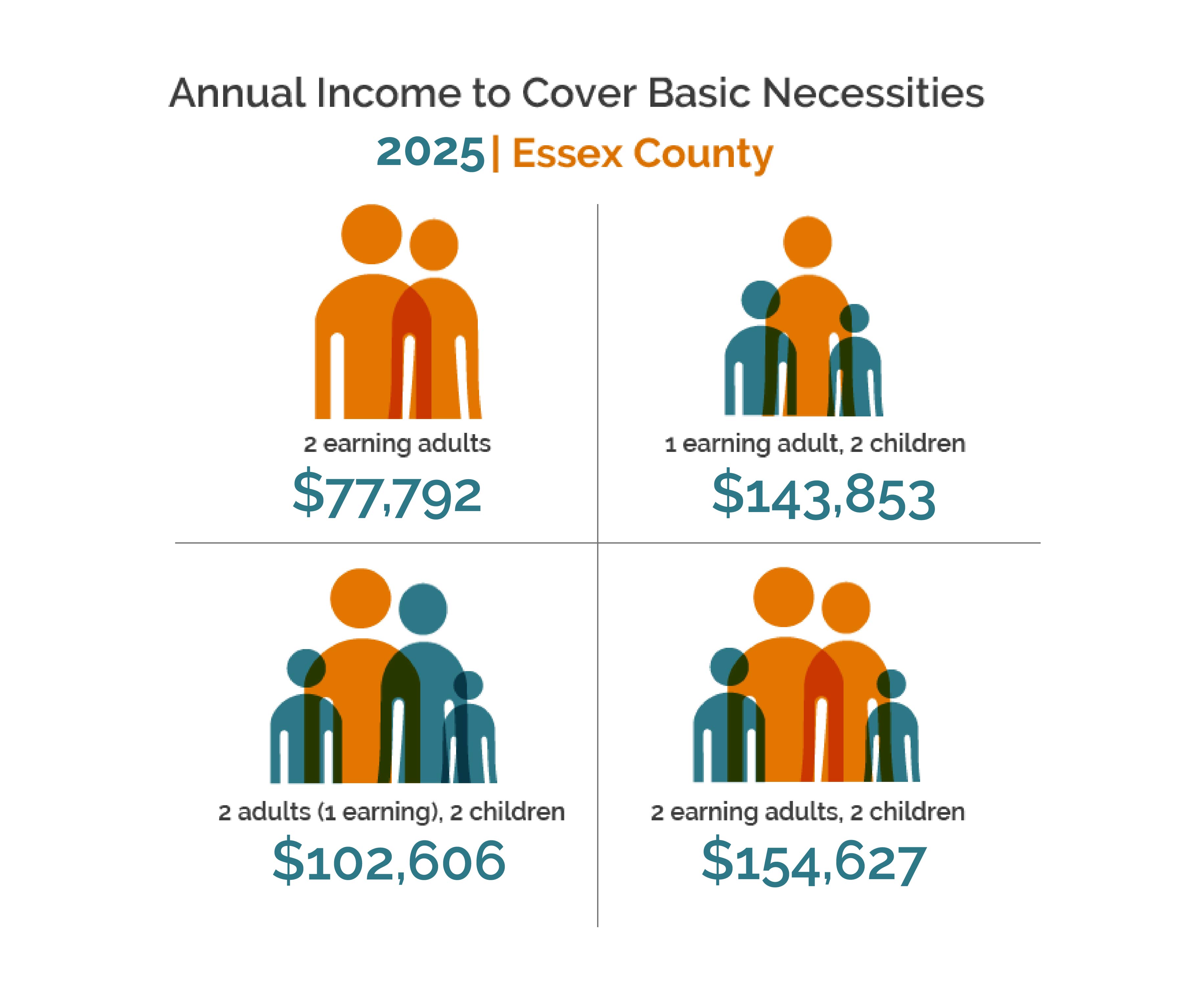
Essex’s housing problems aren’t driven by an overall high poverty rate or low incomes, but it’s an expensive place to live. Estimates of the “living wage” required to afford basic necessities, including shelter, suggest that many families, particularly single-parent families, don’t make enough to make ends meet. For example, the annual income required for a single parent of two is estimated to be nearly $143,900. Compare that to the median income for female-headed households with children: $37,500.
In what ways is unstable housing impacting Essex County?
We don’t have data specific to the homeless or housing-insecure population to answer this question. But we know that physical health, mental health and educational performance of unhoused or housing-insecure people are all affected. How Essex County can make safe, secure, affordable housing available to all residents remains a key challenge facing the community.